EDIZIONE INGLESE 
|
Founded in 1098, the later cloister of Citeaux is the birthplace of the Cistercian Order.
From here the Order spread to all parts of Europe. The Order's strict way of life is also reflected in the unadorned simplicity characteristic of its architecture, an expression its spirituality.
The world of the Cistercians has exerted a great appeal right up to the present day - embodying as it does virtues of rural life in contrast to the problems of modern urban life. Cistercian cloisters are also an allegory of medieval utopia that reminds us of the fundamental questions in life. It is the harmony of ethics and aesthetics to be found in Cistercian structure that is the source of the fascination they excite. More than 50 cloisters from all over Europe
are presented here at length with brilliant photographs and informative texts - a work that transports the reader back to the very roots of Christianity in Europe.
Nine centuries ago, at a time when Benedictines from the Order of Cluny glorified God in splendid divinee offices and magnificent churches an unknown monk called Roben de Molesme suggested that they revert to the strict rule of Benoit de Nurcie: in prayer, seclusion and a life of manual labor. The "New Monastery",
Cîteaux thus became a model for a сohort of "Cistercians", choir monks аnd lay brothers from some seven hundred abbeys across Europe, not to mention the nunneries linked to them.
Thanks to Bernard de Clairvaux, the most famous of the "White Monks", the new Order soon evolved into the leading conscience of Christendom by both controlling political power and by rallying the entire feudal system in pursuit of the greatest glory of God.
Once stripped of all ornament, the architecture of the Cistercian abbeys imposed a new aesthetic standard both on Romanesque art, which was perfected by the master craftsmen of the Order, and on early Gothic art, which they helped to develop throughout Europe. The Cistercian agricultural and industrial estates likewise
made a highly effective contribution to the technological revolution of the 12th and 13th centuries.
Jean-François Leroux-Dhuys and Henry
Gaud focus on this episode of the history of the Cistercians in relation to their architectural legacy. But their analysis, unlike many existing works in this field, is not confined to the medieval period. The
fascinating history of the cistеrcian Order
continues to this day and has played an essential role in the evolution of both the Catholic Church and the political structure of European states.
The "White Monks" demonstrated exemplary skills in building and adopting the various styles of their day, in particular elements of baroque architecture, which inspired some as yet little known masterpieces presented here in this volume.
The vestiges or ruins of Cistercian abbeys continue to attract crowds of visitors even today. This book offers insight into the contemporary heritage of the Cistercian Order. |
CONTENTS
Part one NINE CENTURIES AGO
ORIGINS AND FOUNDATION
Chapter I: The Origins of Christianity
Chapter II: Christianity in the Late Eleventh Century Chapter III : From Molesme to Cîteaux
PURITY AND POWER
Chapter IV: Bernard of Clairvaux
Chapter V: Monastic Architecture According to Bernard of Clairvaux Chapter V: Romanesque Architecture in the Early Cistercian Period
THE POWER AND THE GLORY
Chapter VI: Cistercian Europe
Chapter VIII: Political and Religious Glory
Chapter IX: Economic Power
Chapter X: The Essence of Architecture
CENTURIES OF TRIAL
Chapter XI: The Trials of the Later Middle Ages
Chapter XII: The Breaking Up of The Order
Chapter XIII:Swansong
Chapter XIV: Yesterday, Today and Tomorrow
Part Two THE CISTERCIAN WORLD IN EUROPE
Acey, France
Alcobaça, Portugal
Bebenhausen, Germany
Bective, Republic of Ireland
Boyle, Republic of Ireland
Buildwas, England
Byland, England
Casamari, Italy
Chiaravalle della Colomba, Italy Chiaravalle Milanese, Italy
Cîteaux, France
Clairvaux, France
Dunbrody, Republic of Ireland Dundrennan, Scotland
Flaran, France
Fontenay, France
Fontfroide, France
Fontmorigny, France
Fossanova, Italy
Fountains, England
Furness, England
Heiligenkreuz, Austria
Holy Cross, Republic of Ireland
Нore, Republic of Ireland
Jerpoint, Republic of Ireland
Léoncel, France
Lérins, France
Loc Dieu, France
Margam, Wales
Maulbronn, Germany
Mellifont, Republic of Ireland
Melrose, Scotland
Morimondo, Italy
Noirlac, France
Obazine, France
Orval, Belgium
Osek, Czech Republic
Otterberg, Germany
Poblet, Spain
Pontigny, France
Portalegre, Portugal
Rievaulx, England
Royaumont, France
Salem, Germany
San Galgano, Italy
Santes Creus, Spain
Sedlec, Czech Republic
Sénanque, France
Silvacane, France
Silvanès, France
Staffarde, Italy
Sweetheart, Scotland
Le Thoronet, France
Tintern, Wales
Tintern Minor, Republic of Ireland Tisnov (Porta Coeli) Czech Republic
Valcroissant, France
Valle Crucis, Wales
Valmagne, France
Veruela, Spain
Villers-la-Ville, Belgium
Vyssi Brod, Czech Republic
Zdár, Czech Republic
Zlata Koruna, Czech Republic
Zwettl, Austria
Notes
Index of Names and Places
Acknowledgments |

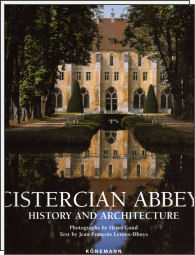
Henri Gaud - Jean-Francois Leroux-Dhuys
CISTERCIAN ABBEYS
editore KONEMANN
edizione 2006
pagine 399
formato 26x31
cartonato con sovracoperta colori
tempo medio evasione ordine
ESAURITO
39.00 €
39.00 €
ISBN : 978-3-8331-2077-0
EAN : 9783833120770
|
|










 ebussi50@gmail.com